

Great Books (Re)Read
A few texts always worthy of additional looks

I am amazed by an impossibility whenever I enter my local bookstore: it is impossible to read every book in the store over the course of a life, even if you are a voracious bibliophile. Assuming you want to expose yourself to new thinking, hypotheses, and stories, you may ask why would anyone reread a book?
Take my local Barnes & Noble. It likely has around 100,000 books. The average reader would need more than 8,000 years to read that many books. That’s more than 100 lifetimes!
So, why might anyone reread a book they once read? Why might they chose to spend their most valuable life asset — time — to revisit a text already discovered?
I thought about this question often last year. I was highly focused on exploring new literary spaces and genres with a keen eye toward Australian writers. I discovered the famed Aussie writer, Tim Winton and read two of his classic works: Cloudstreet and Breath.
Yet, a little voice kept whispering in my ear, like a singing sparrow incessantly trying to get my attention. Every time I finished a book, she’d call from the back of my mind in the voice of my high school english teacher. “You should reread this book when you’re older. Trust me! You’ll appreciate it more,” she’d say, encouraging me to reread a Dickens classic.
She was referring to Great Expectations, Charles Dickens famed work on becoming at any cost. In October, I decided to take heed to her calls, to make it one of the final books I’d read in 2025.
While the Dickens’s conclusion was still a little dissatisfying, my teacher was correct. I appreciated Pip, Ms. Havisham, and Estella’s story more as a 40+ father with a career than I did as a 15-year-old with blackheads who was still looking forward to entering the workforce.
Without delivering a full book report, Dickens’s themes of embracing career benefactors; trying to make it in a cruel world; finding love without sacrificing oneself; and more are timeless.
Rereading Great Expectations made me ask a simple question: what other books should I reread? What other books are worth the opportunity cost of selecting anew from the Borders infinite wall of discovery?
Paulo Coelho’s classic international bestseller, The Alchemist quickly bubbled up from my subconscious like CO2 rising from a scuba diver. I pulled it from my shelf and reacquainted myself with the journey of Santiago, the shepherd boy from Andalucia trying to realize his dream.
If you haven’t read The Alchemist, read it. If you have, read it again! At its core, it’s about following your dreams; balancing love for another with love for oneself; accepting unexpected help from others; maintaining focus during life’s inevitable pitstops; helping others embrace a growth mindset; reconciling where you’ve been with where you’ve started; and, most importantly, doing what others will not to achieve your dreams.
My favorite part of the book is that the climax, tension, and answers to the many unanswered questions doesn’t happen until the last sentence. It leaves you on edge with each turn of the closing pages wondering when or even if you will be satisfied.
Inspiring Alchemist Quotes
During this reading, I kept track of powerful quotes from the book that spoke to me. There is likely more wisdom in this book than any non-fiction career self-help book you will find on Amazon, at a conference, or in the self-help section at your local bookstore.
You’ll have to read the book to fully experience its timeless messages. To wet your appetite, here are a few that may speak to you as they did me.
…dreams are the language of God. When he speaks in our language, I can interpret what he has said. But if he speaks in the language of the soul, it is only you who can understand.
Everyone seems to have a clear idea of how other people should lead their lives, but none about his or her own.
“What’s the world’s greatest lie?” the boy asked, completely surprised. “It’s this: that at a certain point in our lives, we lose control of what’s happening to us, and our lives become controlled by fate. That’s the world’s greatest lie.”
He still had some doubts about the decision he had made. But he was able to understand one thing: making a decision was only the beginning of things. When someone makes a decision, he is really diving into a strong current that will carry him to places he had never dreamed of when he first made the decision.
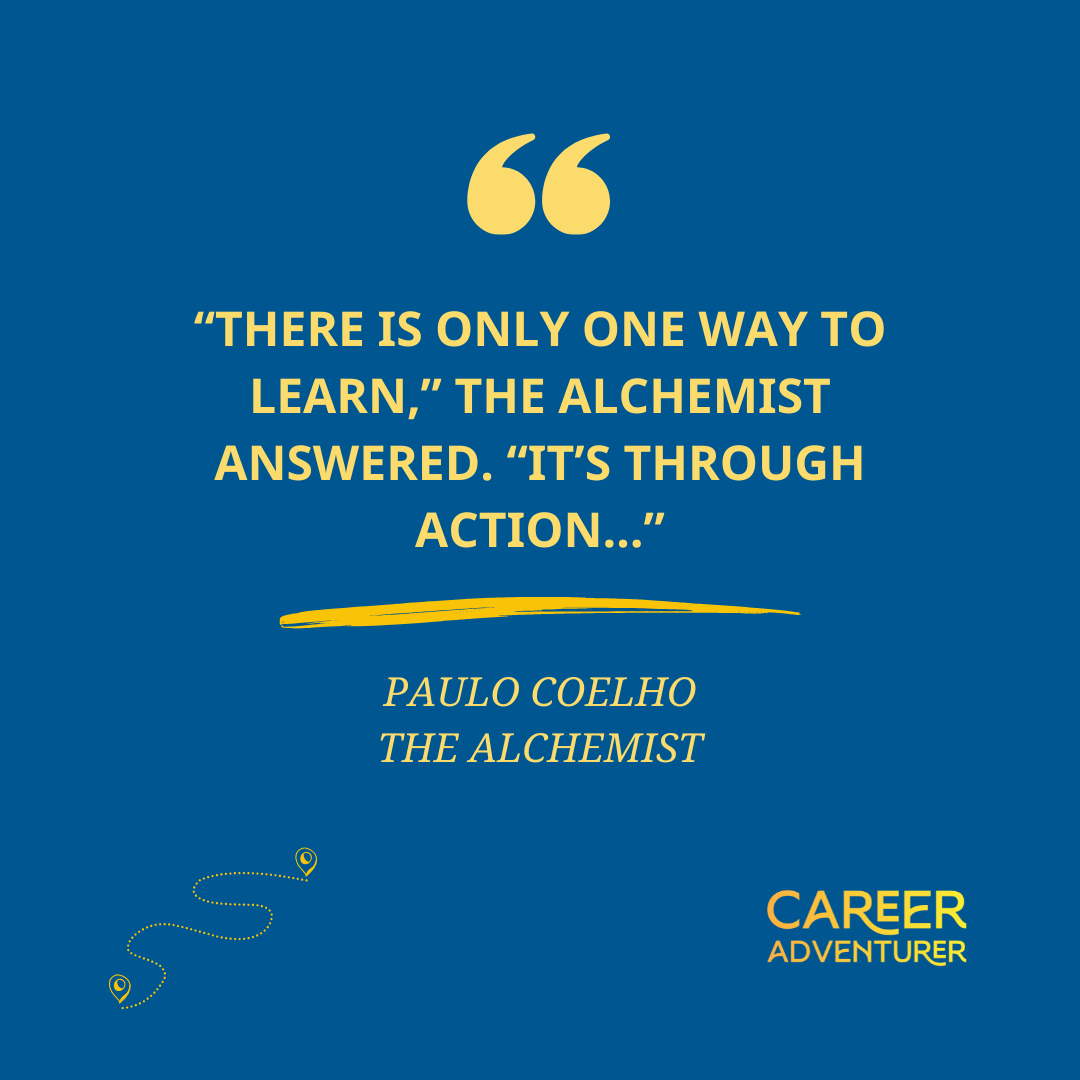
“There is only one way to learn,” the alchemist answered. “It’s through action…”
People are afraid to pursue their most important dreams, because they feel that they don’t deserve them, or that they’ll be unable to achieve them.
If a person is living out his Personal Legend, he knows everything he needs to know. There is only one thing that makes a dream impossible to achieve: the fear of failure.
Other Books to (Re)Read
Once I completed The Alchemist, I asked myself what other books I should reread? The first criteria for selection was, the book must be entertaining. Here’s three.
Mythos, Stephen Fry
I loathed my college classic civilizations courses, not because of disinterest in the Romans or Greeks. Rather, the readings were encyclopedic. Lectures were like listening to a live reading of the same encyclopedia. Snooze fest!
Decades later I discovered Mythos, Stephen Fry’s retelling of classic Greek Mythology. He starts with the origin stories of the First Order, Second Order, and Olympians before diving into classic tales, permutations of progeny, and which God slept with whom. He does it all with comedic wit to make the prose resemble narrative fiction and not Brittanica.
Catch 22, Joseph Heller
The classic tale about Yossarian trying not to get killed in World War II. I remember laughing out loud while reading this book on an airplane. My seat neighbor noticed the root of my chuckle and gave a “I love that book” nod of appreciation.
I recently encouraged a friend to free his copy from its job gathering dust on his bookshelf and read it. It doesn’t disappoint. Heller pokes at the absurdity of life, war, and bureaucracy all while coining the Catch 22 conundrum we can face in life and work, almost daily.
What If?, Randall Munroe
Do you like absurd questions? Would you like it if someone offered up a scientific approach to answering ridiculous queries? If so, you’ll enjoy What If?.
I routinely scan it before bed. The questions and answers are typically no more than a few pages making them delightfully calorie free late night snacks, when your eye lids get heavy and you shouldn’t be on your phone. Here’s an example: How hard would a puck have to be shot to be able to knock the goalie himself backward into the net? Munroe then provides a well thought out scientific answer to seemingly unanswerable questions. It’s fun and the questions will fuel your brain!
Read or ReRead, Just Read
We rewatch movies all the time. I’ve seen Harry Potter and The Chamber of Secrets a half dozen times in the past two months because my daughters continuously want to rewatch it.
Reading the same book six times in two months is likely a bit much. Yet, rereading it from time to time may boost your mood, help you remember important life lessons, or give you a more productive form of entertainment than watching Michael Scott bumble his way around The Office for the nineteenth time on Comedy Central.
So I ask, what books are part of your steady rotation? Or, which ones should be?
Thanks for reading!
Paul G. Fisher